 Image: Blog hero Plant Plate 09 boys dig in
Keep the History, Boost the Accessibility
by Blandin Foundation Posted in Grants
When Two Harbors Public Library leaders learned their building wasn’t meeting the needs of patrons with disabilities, they took action
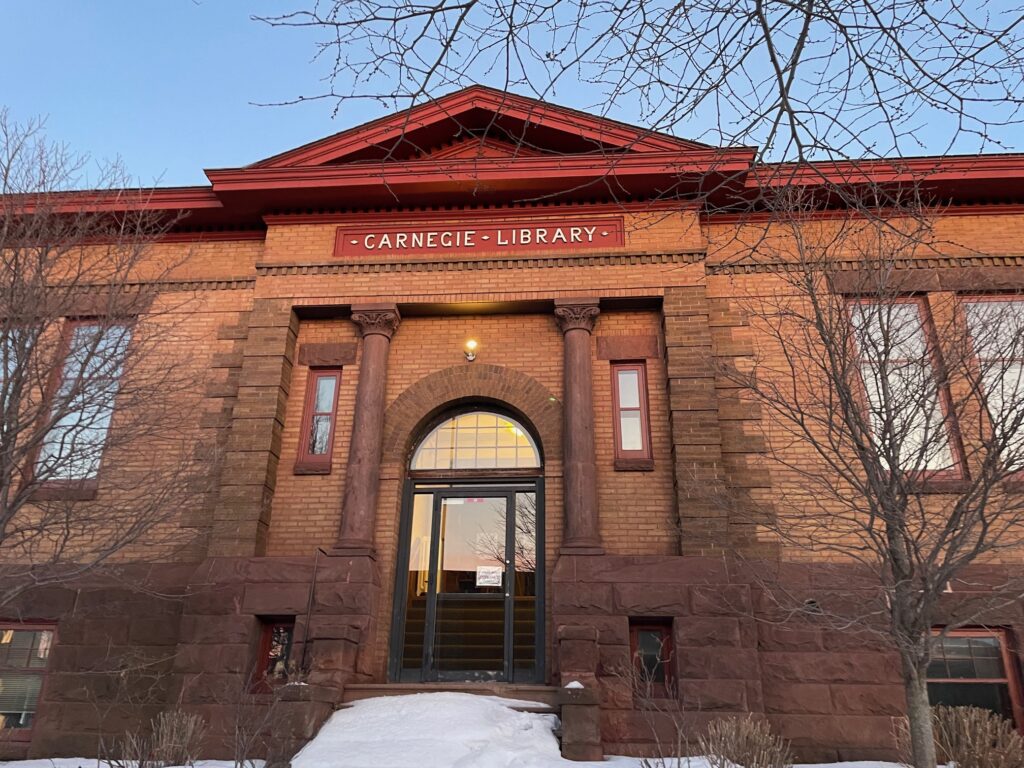
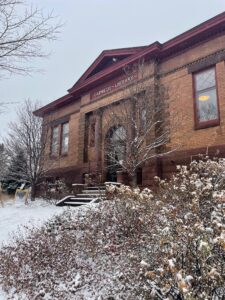
Two Harbors Public Library, located just a few blocks from Lake Superior along Minnesota’s northern shore, was built more than 115 years ago and has been on the National Registry of Historic Places since 1986. When you arrive, you’re met with charming pillars and original wood and brickwork. It’s a landmark in the region and a popular gathering space, both for residents and for visitors and tourists who come to town.
“We really appreciate this historic building,” Madeline Jarvis, director of Two Harbors Public Library, told Blandin Foundation. “That being said, there are certain limitations when you’re in a beautiful space that was only designed for folks of certain abilities.”
The building’s public restrooms were last updated in 1983 — seven years before the Americans With Disabilities Act (ADA) went into effect. Among many other directives, the ADA mandates that development of new public buildings must meet specific guidelines to support the needs of community members living with disabilities; however, older, historically protected buildings like Two Harbors Public Library were made exempt from bringing their facilities up to ADA compliance.
“Our beautiful building was inaccessible to many of our community’s patrons and visitors,” Jarvis shared. “That’s not something I could live with. That’s not something we could live with. Knowing that you are allowed in versus knowing you are welcomed in and appreciated, those are two very different things. Especially knowing that the whole reason the library exists is to provide access, information and ideas.”
Jarvis and the rest of the Two Harbors Public Library team knew their building’s pressure points. They knew visitors could get in and out of the library but also understood that true accessibility meant much, much more than that. They also knew that improving and adding accommodations for people living with disabilities can have a positive impact on a community’s broader, non-disabled population as well, a phenomenon known as the “curb-cut effect.” Other examples of this effect include closed captioning on TVs, automatic opening doors, hybrid and remote work environments, and more. Jarvis began looking into improvements she could make so people living with disabilities would feel more welcome during their visits.
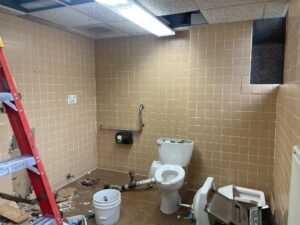 “In Two Harbors in particular, it’s such a vulnerability to say that you have needs — especially ambulatory needs,” Jarvis shared. “The bathrooms were an area that we had identified, and we knew we would be able to receive funding through the city to improve those, but not necessarily in a way that would truly meet the accessibility needs of folks throughout our community.”
Enter Jenna Udenberg, a Two Harbors resident, author and accessibility consultant. Udenberg was part of Blandin Foundation’s Community Leadership Program back in 2017, and in the years since she founded Above & Beyond With U, a nonprofit dedicated to advocating for the needs of students and families living with disabilities. She’s been a full-time wheelchair user since she was 7 years old, and growing up she struggled with access to some of Two Harbors’ most-visited areas — including the public library.
“I have maybe one memory of being in the library as a child … It was a place I didn’t always feel comfortable in,” Udenberg shared. “When I came back to town to become a resident and music teacher after my undergrad, I realized what a cool place it is, and I thought surely it must be accessible now. But I went in there and nope! Darn. But then I got to know Madeline Jarvis, and she expressed her interest in being welcoming and inclusive of everyone and meeting those basic needs.”
Udenberg told Jarvis about Blandin Foundation’s Rural Leadership Boost Grants program and encouraged the library director to apply.
“I appreciated the flexibility within the grant funding to actually understand and unpack what a community is looking for, so rural communities can be the experts in what they see as a solution,” Jarvis said of the application process. “I put together the grant proposal, with input from our board, Jenna, and other library volunteers and stakeholders, then sent it off and crossed my fingers.”
In addition, all 26 members of Udenberg’s 2017 Blandin Foundation Community Leadership Cohort unanimously put their names on the application in support of the project.
Blandin’s Rural Leadership Boost Grants were launched to support local vision and ignite the dreamers and doers ready for growth. The first round of grants totaled $1.35 million for 26 projects across rural Minnesota, including Two Harbors Public Library. The day Jarvis got notice that her proposal had been selected, it was a snowy afternoon in 2022.
 “I was watching the snowfall, because how could you not? There’s something magic about that first snow … but it’s also fear for [some folks living with disabilities],” she said. “And then I looked down, and I had that email. I had to get up and go on a walk. I was like, ‘I’m clearly seeing things. There’s one more zero than I’m expecting to see in this number!’”
Jarvis immediately contacted the rest of the library staff, and then began reaching out to contractors. First on the list was a universal changing table, which can be used to support children or adults who need assistance with personal care. Caregivers who use wheelchairs or other mobility devices and who aren’t able to reach a traditional child-sized changing table can also more easily change their children with this kind of device. It became the first publicly accessible universal changing table in greater Minnesota.
THPL also installed new grab bars in the bathrooms after discovering the old ones were placed in spots that weren’t actually helpful for patrons with disabilities. They added an accessible water fill station. They put in new, more accessible computer carrels. Their old front desk was less-than-welcoming — “like a fortress, with a wall, where guests have to look up to be able to receive help” — which Jarvis remedied with a new sit-stand desk so the team can better greet and support visitors. They were able to purchase an ergonomic mouse, a left-handed mouse, and two large-font keyboards for visitors who might benefit. The team even received training from Kulture City, the world’s leading nonprofit on sensory accessibility and acceptance, and became the first public library in Minnesota to be certified sensory-inclusive.
“We received training on sensory needs within invisible disabilities, audited our space and updated signage as to which areas are designated quiet and which areas will get loud, and we developed a social story to help folks plan their library visits,” Jarvis explained. “When you walk in the door, it says public library right above you. We take that very seriously. If we are truly for the public, it needs to look like it, and it needs to feel like it.”
The impact these changes have had on the Two Harbors community has been incredible, Jarvis told Blandin Foundation.
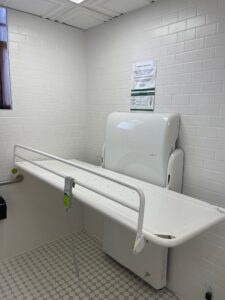 “Every time I hear a new story, I cry on my drive home. It can be as simple as somebody wasn’t able to bring their child grocery shopping before, but now that we have this universal changing table, there’s a place where they can bring their child if they need to. One parent of an elementary-aged child who uses a wheelchair shared they planned their entire North Shore trip around the open hours of the library. They were able to go on vacation because they knew there was a place where they could bring their child instead of changing them in a public parking lot.”
“I was sharing the story of this project with a local mom whose daughter uses catheters, and she immediately got teary-eyed,” Udenberg added. “She said, ‘If only this existed when my kid was growing up, what a game changer that could’ve been, and will be.’” Now, the public library is Udenberg’s favorite place to take her work. “During the summer months, every week I was there for a couple of hours at least. I don’t have to think ahead anymore. I don’t have to pack up all of my gear and leave, go [somewhere else] to use the restroom, and then come back.”
Library patrons have also become more comfortable getting vulnerable and sharing what’s working for them. Jarvis has heard directly from non-disabled caregivers about how much they appreciate the restroom changes. Some have even offered improvement suggestions of their own, like when the bathroom renovations forgot to include a coat hook by the new universal changing table.
“I feel like patrons might not have suggested that had we not made the library a more welcoming spot,” Jarvis said. “Once they see that you’re not just willing and open to make changes, but eagerly seeking and making changes, they’re going to be more willing to say, ‘What about this little thing?’”
Kyle Erickson, director of rural grantmaking at Blandin Foundation, added, “This is the kind of win we’re ultimately shooting for: an inclusive/access project that changes how a community thinks about and engages with how they engage with an important issue.”
In the United States, more than one in four people live with some kind of disability — a number that doesn’t include people who will experience disability in the future. It’s this number, as well as stories from folks commending the changes made to the building so far, that keep the team looking for new ways to improve the space.
“Disability could happen to any of us,” Jarvis said. “When we discriminate against disability culture, we’re often discriminating against our future selves. My office overlooks the front desk, and I see things that we are continuing to work on and continuing to champion and challenge.”
“Huge kudos to Madeline, because at any point she could’ve said, ‘This isn’t required by law. This isn’t required by ADA code yet, and we’re rural and running into roadblocks,’” Udenberg shared. “She could’ve said no, but she was passionate about it.”
The Two Harbors Public Library project is just one example of how rural leaders are taking charge and making change that then extends well beyond their own communities. The recently completed Minnehaha Elementary School in Two Harbors also included a universal changing table in one of their restrooms after learning about the library’s renovations. During the course of the THPL project, Governor Tim Walz signed into law a bill requiring new large-scale public construction projects to include a universal changing table.
“So we’re not just talking about your itty-bitty libraries. We’re talking about your new sports stadiums and malls,” Jarvis pointed out. “When somebody tells you what they need, you need to believe them. This continues to be a conversation, not just for our library staff team, but also for our patrons and for our community. This is work that ends in a comma, not a period.”