Clearwater County
| Year | 100/20 Mbps | 1 Gbps |
|---|---|---|
| 2025 | #16 – 98.37% | #7 – 98.21% |
| 2024 | #14 – 98.33% | |
| 2023 | #13 – 98.28% | |
| 2022 | #9 – 98.85% | |
| 2021 | #4 – 99.59% | |
| 2020 | #22 – 89.32% | |
| 2019 | #18 – 89.3% | |
| 2018 | #13 – 89.3% | |
| 2017 | #23 – 73.41% |
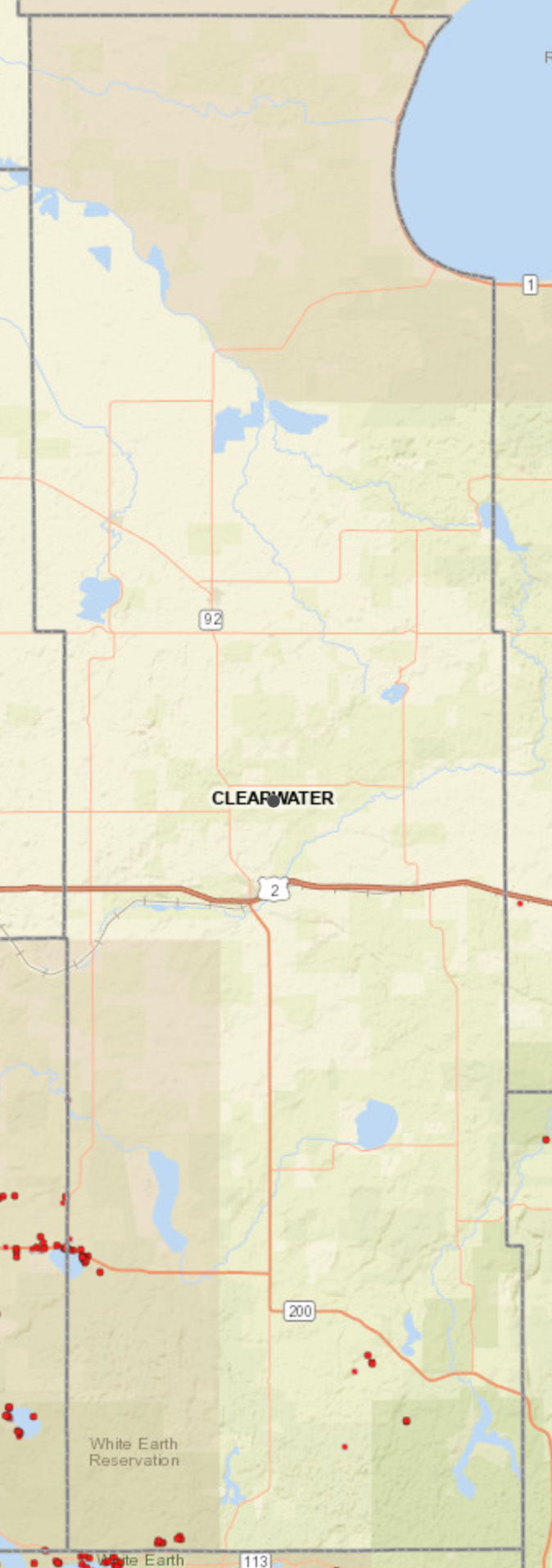
Red dots represent unserved locations.
Clearwater County: Stagnant but so close
At the time of writing, the MN BEAD final proposal has not been approved, but the current proposal would mean coverage for 8 locations in Clearwater County. However, all of locations will get a satellite, which does not qualify as served in the MN statute. It’s telling to see that only 8 addresses in the county got BEAD bids.
There is still Line Extension funding yet to be distributed, which helps connect handfuls of houses just beyond existing infrastructure. (Clearwater has not benefitted from earlier Line Extension awards. Maybe it’s something worth considering.) Statewide, there have been changes with local and national broadband providers, which also leads to uncertainty.
Despite staying stagnant, Clearwater is too close to goal to get any ranking other than green.
Household Density
3.4
Number of Providers
8
As of 2025 · Source: MN DEED
Households with Device Access
statewide
statewide
statewide
statewide
statewide
Has Worked with Blandin Foundation
No
Has Received MN Grant(s)
Yes
In 2018, Garden Valley Telephone Company received a $20 million loan from the USDA to deploy fiber in Polk, Clearwater, Pennington, Marshall and Red Lake counties.
AT&T launched a new FirstNet cell site in Clearwater County.
2024:
- County: Clearwater, Mahnomen
Garden Valley Telephone Company 2024 Rural Mahnomen County
Grant: $4,626,012
Local Match: $1,542,008
Total Budget: $6,168,020
This Low Density Garden Valley Telephone Company in Mahnomen County project is a combination middle mile and last mile Fiber-To-The-Home (FTTH) which will serve locations within the borders of the White Earth Reservation in Mahnomen County. This project recognizes broadband has become essential to economic prosperity in the rural communities and would allow employees to work from home, provide children with access to homework and essential internet related research and improve access to telemedicine at 287 locations, of which 181 are unserved and 106 underserved. Partner funding total of $250, from local community members.